Greta Neumann · 4 September 2026
Iterative Student Feedback Mechanisms Enhance Content Refinement Across Digital Education Platforms
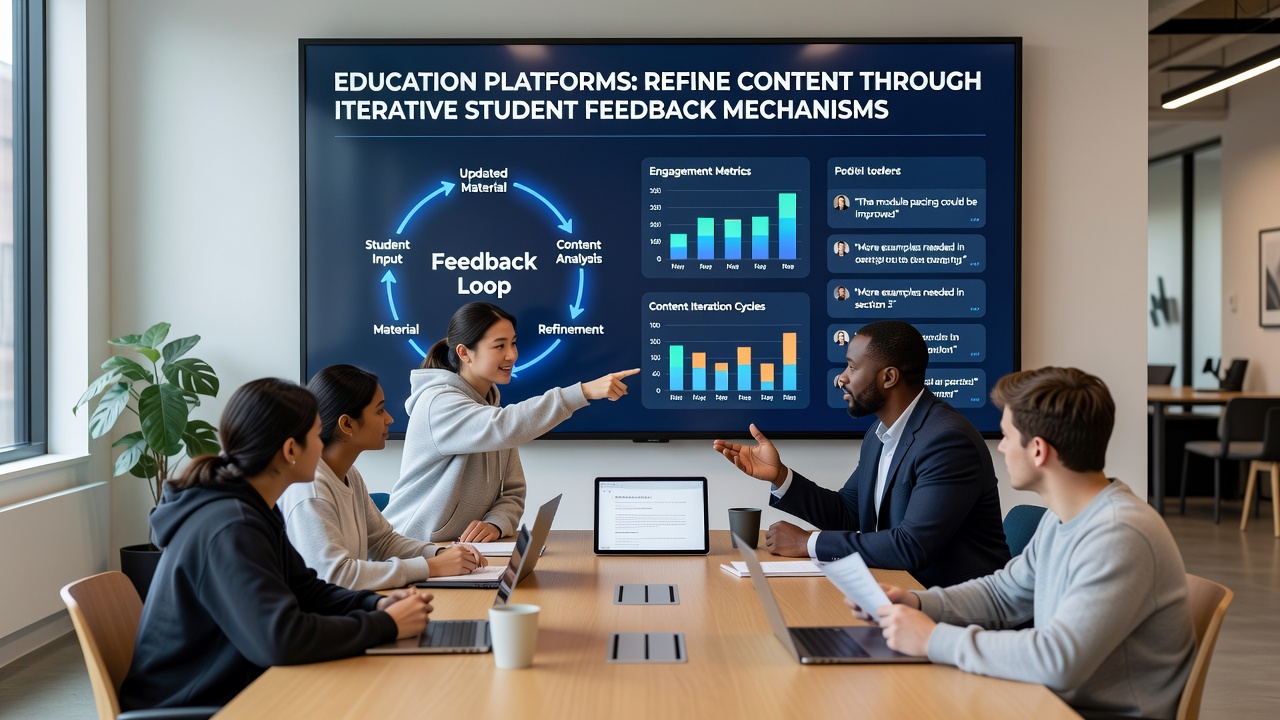
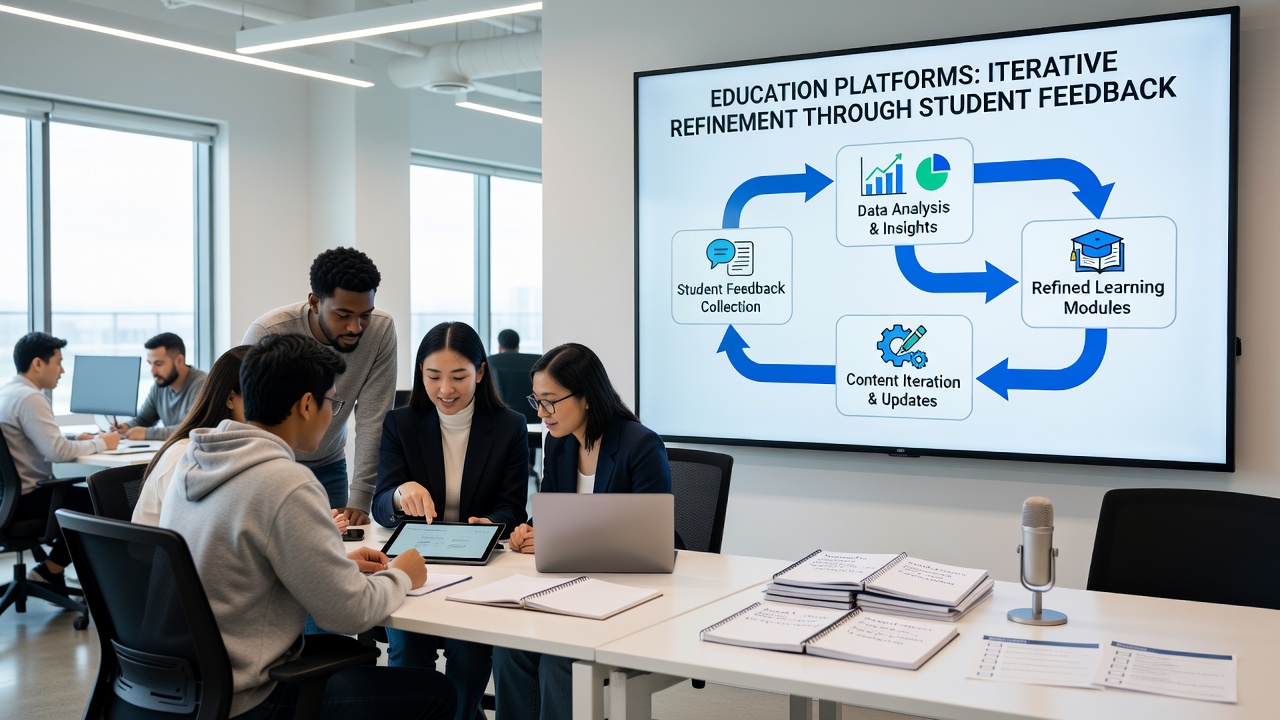
Education platforms collect student responses through quizzes, surveys, and interaction logs, then apply those inputs to adjust lesson sequences, explanations, and assessment items in successive cycles. Researchers at multiple institutions have documented how these loops operate on a weekly or even daily basis, allowing modules to shift emphasis when completion rates drop or error patterns repeat across thousands of learners. Data shows that platforms using such systems report measurable gains in retention metrics, with some studies tracking cohorts over multiple semesters to confirm sustained improvement.
Take the example of a mathematics module on quadratic equations where initial feedback reveals widespread confusion around vertex form. The platform flags the section, surfaces alternative explanations drawn from high-performing student submissions, and reorders practice problems to introduce simpler cases first. Observers note that this process repeats across subjects from language acquisition to biology, with each iteration drawing on aggregated performance indicators rather than single-user comments.
Core Components of Feedback-Driven Refinement
Systems typically combine three elements: real-time data capture, algorithmic analysis, and human review by curriculum teams. Capture occurs through embedded prompts that ask learners to rate clarity or flag difficult concepts, while background tracking records time spent on each screen and retry rates on exercises. Analysis tools then cluster similar responses, highlighting topics where a threshold percentage of users encounter difficulty. Curriculum specialists examine the clusters and decide whether to revise text, add video segments, or insert prerequisite refreshers before approving the updated version for wider release.
According to figures released by the US Department of Education in mid-2025, adaptive platforms that closed feedback loops within seven days achieved higher average post-test scores than static counterparts. The same report noted that institutions in Australia and Canada reported parallel patterns, suggesting the approach travels across different regulatory environments and student populations.
Implementation Patterns Observed in 2025-2026
During September 2026, several major providers announced expanded tooling that lets instructors set custom thresholds for triggering content reviews. One platform integrated natural language processing to categorize open-ended comments automatically, grouping phrases such as "too fast" or "needs more examples" into actionable categories. Another introduced A/B testing modules so that two versions of a revised lesson could run concurrently, with the system selecting the stronger performer based on subsequent quiz results.
Industry reports from research organizations indicate that these refinements often focus on pacing and scaffolding rather than wholesale content replacement. In one documented case, a history course on the Industrial Revolution reduced average module length after feedback showed drop-off after twelve minutes, then added checkpoint questions that improved completion by redistributing cognitive load. Such adjustments accumulate over time, creating versions that diverge substantially from the original release.
Evidence from Cross-Regional Studies
A 2025 analysis conducted across European universities found that courses employing at least three feedback cycles per term posted 12 percent higher pass rates than those limited to end-of-term surveys. The study compared platforms used in Germany, the Netherlands, and Sweden, noting consistent directional results despite differences in curriculum design. Meanwhile, a separate Canadian report highlighted gains in equity metrics, as iterative adjustments reduced performance gaps between first-generation and continuing students by surfacing support resources earlier in sequences where data indicated need.
Those who've examined the underlying datasets emphasize that success depends on response volume. Platforms require sufficient participation to distinguish signal from noise, which explains why larger providers with millions of active users tend to publish updates more frequently than smaller niche services.
Challenges in Scaling Feedback Integration
Privacy regulations affect how platforms store and process individual responses, requiring anonymization steps before aggregation. Technical teams must also guard against bias in the algorithms that surface revision candidates, since certain demographic groups may phrase difficulties differently. Curriculum teams balance the desire for rapid iteration against the need to maintain academic rigor, sometimes retaining core explanations even when feedback suggests simplification.
Yet data from multiple deployments shows that combining automated signals with expert oversight produces revisions that maintain alignment with learning objectives while addressing learner friction points. Institutions that publish transparency reports on their processes, such as those referenced in OECD education working papers, allow external reviewers to assess both the speed and the substance of changes.
Conclusion
Iterative feedback mechanisms have become standard infrastructure for many education platforms because they supply continuous, scalable input for content decisions. The approach relies on structured data collection, analytical processing, and measured human intervention to produce successive versions that better match observed learner needs. As adoption widens, the volume and granularity of available signals continue to increase, supporting further refinement cycles across subjects and regions.